

Practical Component
An Essential Step
The practical component of the Professional Admission Program enables you to apply your theoretical knowledge in real-world settings, develop your autonomy, and demonstrate the mastery of six key competencies under the supervision of a professional engineer who is a member of the OIQ. To complete this component, you must accumulate a minimum of 24 months of supervised experience and demonstrate that you have achieved the required competencies during this period. The requirements may be completed over one or more supervised periods, depending on your career path.
Overview
- A minimum of 24 months of supervised experience
- Six competencies to be achieved, broken down into 28 competency elements
- A scale with levels from 0 to 5 to assess each competency element
- All steps in the process are completed through your online portal
Practical Component Guide
This document provides a more detailed overview of the practical component, outlining its objectives, requirements, and the steps to follow. It is intended for Candidates to the Engineering Profession (CEP) as well as those who supervise them. It also describes the roles and responsibilities of all parties involved.

Competency Reference Guide
This document presents the indicators for the competency elements that must be mastered for the practical component. Rating scales from 0 to 5 are used to evaluate each element’s level of achievement. The 28 competency elements do not need to be completed during each practical training period. Instead, they are assessed cumulatively across all work experiences and serve as reference points throughout your training.
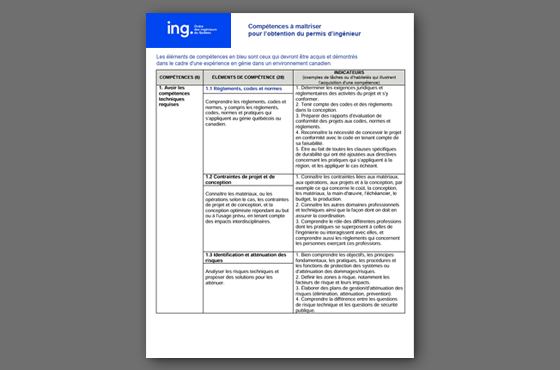
Competencies, Elements, and Indicators
Key concepts to help you navigate the practical component:
COMPETENCIES
There are six core competencies that apply across all engineering disciplines. They represent broad categories of professional skills that must be developed.
COMPETENCY ELEMENTS
Each competency is broken down into more specific elements, for a total of 28 competency elements to be demonstrated. These elements are assessed cumulatively across all work experiences.
INDICATORS
Indicators are concrete examples of tasks or skills that illustrate mastery of a competency element. They serve as reference points to help you prepare your justification when submitting an experience for evaluation.
Eligible Types of Practical Training
Your practical component may consist of one or more training periods of different types. An overview is provided below. Full eligibility criteria are outlined in the Practical Component Guide.
INTERNSHIP
Completed after obtaining 60 university credits and before earning the degree or its equivalent. A summer engineering position may be recognized as an internship if it is supervised by a professional engineer.
ENGINEERING WORK EXPERIENCE
Any supervised experience that begins after the degree has been obtained (or after the equivalency date for individuals educated outside Canada). Periods of less than six months are rarely accepted. It is strongly recommended to wait at least 12 months before submitting technical competencies.
MASTER’S OR DOCTORAL DEGREE IN ENGINEERING
A research period completed as part of a research‑based master’s degree or a doctoral program in engineering. An applied project is eligible if it lasts a minimum of six months on a full‑time basis.
CERTIFICATION OR OTHER TRAINING
Certain training activities, such as university‑level engineering courses or certifications offered by an authorized organization, may help demonstrate the acquisition of specific competency elements, provided they include a significant practical component. However, these activities are intended only to support the demonstration of competencies and cannot be counted toward the required months of experience.
Supervision
Throughout the practical component, you will work under the supervision of a professional engineer with a valid permit. Your supervisor is a partner in your professional development. They will help you set objectives, provide regular feedback, and evaluate your progress at the end of each training period.
The OIQ places great importance on the supervisor’s evaluation. Their evaluation of your competencies helps validate your self-assessment. If the two evaluations differ, the supervisor must provide written justification in their portal.
ELIGIBILITY CRITERIA
To act as a supervisor, the engineer must:
- Hold a valid engineering permit
- Have sufficient, relevant, and recent professional experience (at least three years)
- Be in good standing from a disciplinary standpoint and have no limitations to practice
- Be proposed to the OIQ by the CEP (via the portail) and be approved before the start of the practical training period
More information on supervision requirements is available in the Practical Component Guide or on the Find a Supervisor page.
Roles and Responsibilities
The practical component is based on shared responsibilities between you (CEP), your supervisor, and the OIQ. Here’s a brief overview:
CEP
- Declare the start and end of each practical training period in their portal
- Select an eligible supervisor and ensure that they confirm their commitment to supervise you through their portal
- Discuss progress regularly and seek feedback from the supervisor
- Gradually document acquired competencies and complete a self‑assessment
- End a training period in the portal when changing jobs or supervisors
SUPERVISOR
- Promptly confirm their commitment to the OIQ
- Support their CEP, set clear objectives, and ensure regular follow‑up
- Provide feedback and assess the CEP’s progress
- Complete the evaluation at the end of the training period
- Inform the CEP of any changes that may affect the supervision
THE OIQ
- Validate the relevance of the training period and the eligibility of the supervisor
- Support candidates and supervisors throughout the process
- Review submitted training and evaluation periods and render a decision
Submitting Your Experiences
All steps are completed through the portal.
When Should You Submit?
You must declare the end of a training period as soon as one of the following situations occurs:
- You leave your job or change employer
- You change supervisors
- You have accumulated at least 24 months of experience and believe you have reached the required level for each competency element
- You have completed an engineering‑related certification
How to Proceed
The process consists of three steps:
- Indicate an end date for your employment period (even if you are still in the position)
- Complete your self‑assessment for each competency element demonstrated
- Submit your self‑assessment
Once submitted, your supervisor will receive a notification inviting them to complete their own evaluation of your progress through their portal.
The periods submitted by your supervisor are then reviewed by the OIQ as they are received. Additional information may be requested, if necessary.
Tips to Help You Succeed
The following tips and best practices are intended to support your preparation for and progression through the practical component.
Review all the documents on this page to clearly understand what is expected of you before beginning the practical component.
Enter your supervisor’s information into your portal and link them to your employer as soon as you start your job or practical training. This will help you avoid having to resubmit months of experience if your supervisor is not approved by the OIQ.
Adjust your practices based on feedback from your supervisor. Each adjustment is an opportunity to learn and improve.
Update your résumé (CV) with your roles, projects, and achievements. This will help you select the most relevant examples to demonstrate your competencies.
Progressively draft your justification throughout your practical training period, using the indicators for each competency element as a guide.
Communicate regularly with your supervisor about your progress. These discussions should take place throughout the process to avoid misunderstandings during the final evaluation.
Schedule a final meeting with your supervisor before submitting your self-assessment through your portal. Ensure that both evaluations reflect your discussions and a shared understanding of your progression.
You do not need to complete all 28 competency elements during each practical training period. Competency elements are assessed cumulatively across all work experiences.
Before submitting an applied project as part of your practical training, ensure that you have worked on it full-time for at least six months.
Additional Information
If you have any questions about the Professional Admission Program, and in particular the practical component, please contact us.
Contact us