
THEORETICAL COMPONENT
A FOUNDATIONAL STEP
The theoretical component is one of three parts of the Professional Admission Program, along with the practical component and language requirements. This component consists of a series of online training modules featuring questions and scenarios similar to those in the professional exam. You can complete these modules in any order. There is no prescribed sequence.
QUICK FACTS
The theoretical component involves:
- Online training modules
- A study guide to help you prepare for the exam
- The professional exam
You can complete the theoretical component at your own pace, within the five-year timeframe for completing the Professional Admission Program. You can start this component while you’re still a student. It’s the only part of the program available to you before graduation.
Keep in mind
There are a limited number of exam dates, so it’s important to plan ahead. Set aside enough time to complete each of the four mandatory modules. You’ll need about 30 hours to finish them all. Once you’re done, we’ll send you a link to register for the professional exam. Don’t wait to register. Registration closes one month before each exam date, so be sure to choose a date that works best for you.
1 – ONLINE TRAINING MODULES
The theoretical component has five modules and takes about 30 hours to complete. Together, the modules cover the material you need to know for the professional exam and to start your engineering practice.
| Module 1 | The Québec professional system and professional development | Required |
| Module 2 | Ethics and professional conduct | Required |
| Module 3 | Laws and regulations | Required |
| Module 4 | Standards of professional practice | Required |
| Module 5 | Supplemental training | Optional |
You can complete these modules in any order and at your own pace. Just be sure to finish them all at least one month before your exam. You’ll continue to have access to the course materials once completed.
2 – STUDY GUIDE
This document provides a summary of the course material you’ll be tested on in the professional exam. Keep it handy as you progress through the modules and prepare for the exam. Be sure to leave yourself enough time to study.
Please note that this document is only available in French.

3 – THE PROFESSIONAL EXAM
- Exam sessions are held in person, at various locations across Quebec.
- In accordance with Quebec legislation, the professional exam is offered in French to all candidates.
- It consists of 110 multiple-choice questions.
- A passing grade is 60%.
You must complete all required modules before taking the professional exam. Once you have completed them, we will send you a link to register. Registration closes one month before each exam session, so complete the modules early enough to get your preferred date. Use this time to review the course material and the study guide. Visit the professional exam page to see upcoming exams.
FEES
| Item | Cost |
|---|---|
| Online training module 1 – The Québec professional system and professional development | 35 $ |
| Online training module 2 – Ethics and professional conduct | 85 $ |
| Online training module 3 – Laws and regulations | 85 $ |
| Online training module 4 – Standards of professional practice | 140 $ |
| Parcours de formations préparatoires à l’examen professionnel (TRP only) | 345 $ |
| Professional exam registration (first attempt or retake) | 285 $ |
Prices include taxes. Certain fees are included in the cost of admission for holders of a Temporary Restrictive Permit (TRP).
UPCOMING CHANGES
This fall, an updated version of the theoretical component will be introduced. This update is designed to streamline the Candidate to the Engineering Profession (CEP) pathway, modernize the content, and better align it with the Professional Examination.
Please note that no additional fees will be charged as a result of this update. Any courses you have already completed will remain recognized in your file, and you will have access to the updated content at no additional cost.
Goals
- Simplify and streamline the learning experience.
- Modernize the theoretical component by offering shorter and more effective online training.
- Align the training materials and study guide with the professional exam.
Key changes
- About 55% of the course content has been revised.
- The study guide has been updated and shortened.
- An optional mock exam has been added to Module 5.
- About ten professional exam questions have been updated.
IMPORTANT DATES
October 20, 2026: Deadline to register for the last exam session based on the current content.
November 23, 2026: Updated version of the theoretical component goes into effect. New content deployment and optimization activities will take place from November 23 to 30, 2026. During this period, the portal may be temporarily unavailable, and some features may be limited.
Starting in 2027: The professional exam will be aligned with the updated course content.
WHAT TO DO
You can either continue your current path or wait for the new version to go live, whichever works best for you. To learn about the possible impacts, review the scenario that best matches your situation.
I haven’t started the theoretical component yet
I’ve completed less than 50% of the theoretical component
I’ve completed more than 50% of the theoretical component
I’ve completed all the required modules, but I haven’t signed up for the exam yet
I’ve completed all the required modules and registered for a 2026 exam
I didn’t pass the exam on my first try
I didn’t pass the exam on my second try
I’ve completed the theoretical component and passed the exam
I have a Temporary Restrictive Permit (TRP). How will the theoretical component update affect me?
FAQ
What content will change?
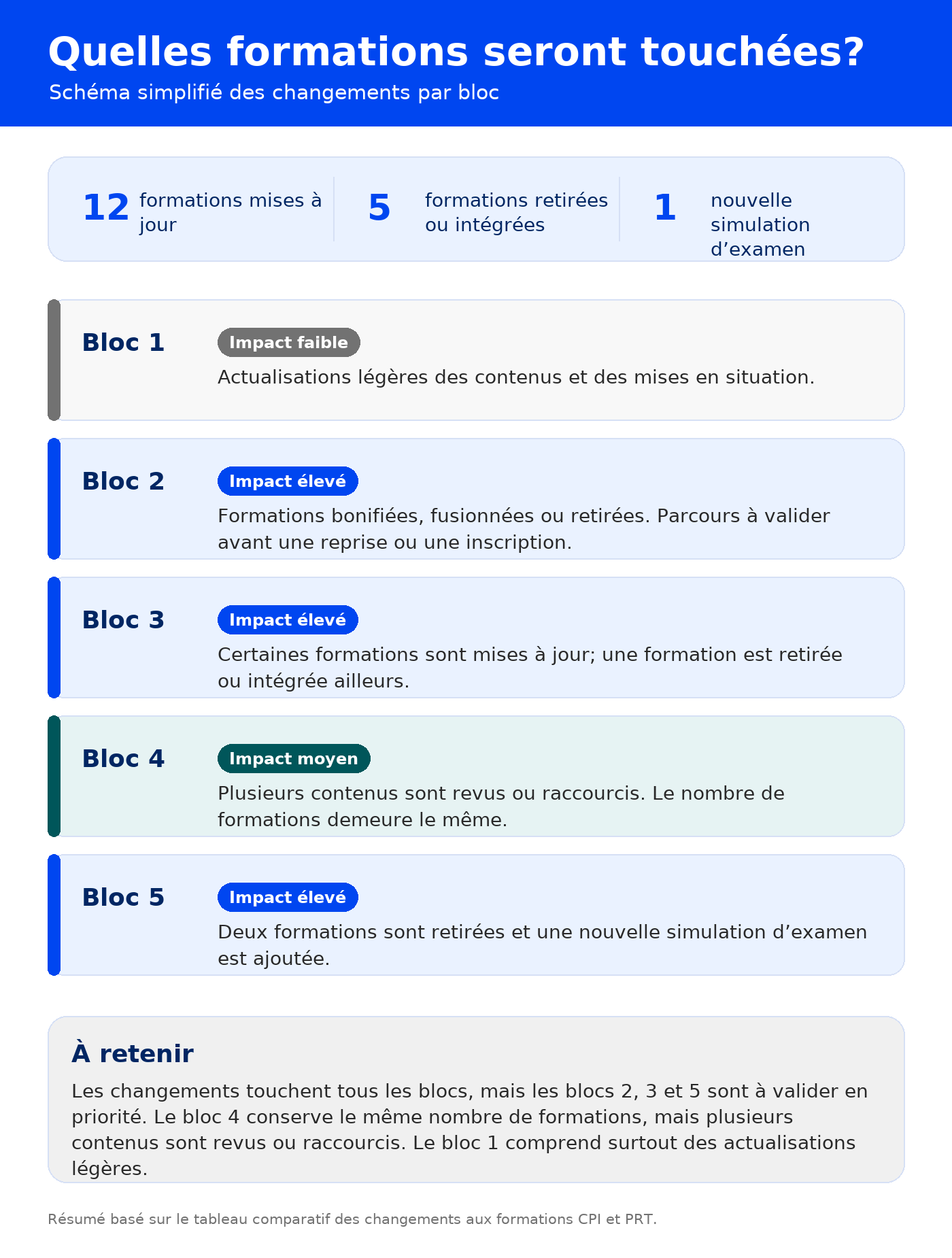
Most modules will be updated, especially Modules 2, 3, 4, and 5. Some content will be added, combined, shortened, or removed. Module 5 will also include a new mock exam. Module 1 will only have minor updates. This diagram in French shows the changes for each module.
What happens to the training courses I’ve already purchased and completed ?
As of November 23, 2026, the current versions of the training courses will be replaced with updated versions in your portal.
If you have already purchased a training module, you will not need to purchase it again as a result of this update. However, any course within that module that is in progress and not completed by November 23, 2026, will need to be restarted from the beginning using the updated version. Courses that have already been completed will retain their completed status in your record.
The theoretical training courses that you completed before November 23, 2026, will remain on your record and will continue to be recognized as completed.
How can I get ready for the professional exam?
Complete the four required modules and review the study guide. Plan for about 30 hours to finish the mandatory modules. Starting November 23, 2026, you can also use the mock exam to practice for the exam. It will be offered at no cost in Module 5.
What is the mock exam?
The optional mock exam in Module 5 will feature questions and scenarios like those you’ll encounter on the professional exam to give you a better idea of what to expect. It will be available at no additional cost starting November 23, 2026.
IN A NUTSHELL
TRAINING MODULES
There will still be four required training modules, but approximately 55% of the content will be updated. The number of courses will decrease from 22 to 19, and the estimated completion time will shorten from 29 to 25 hours. Training courses completed before the update will remain recorded in your file, and you will not be required to pay for them again. An optional fifth module will also be introduced at no additional cost and will include a mock exam to help you prepare.
STUDY GUIDE
The new study guide will be more concise and visually engaging, going from 480 to 130 pages.
PROFESSIONAL EXAM
Only about ten questions out of the 110 will be updated to reflect changes to the training content.
STILL HAVE QUESTIONS?
If you still have questions about the theoretical component or any other part of the Professional Admission Program, we are here to help.
CONTACT US