

29 septembre 2026
Reserved activities: What you can do without breaking the rules—or derailing your career

You’re a CEP or doing an internship. Your manager asks you to update a plan before it’s sent to the client. You’re assigned to run some tests on a system. On another project, a colleague asks you to correct a script related to a PLC. Nothing too complicated, apparently.
The good news: they trust you.
One small concern: you wonder if you’re really allowed to do this.
Short answer: it depends!
Yep, not the most exciting answer in the world. But here, it all depends (really) on how your work will be used: is it being used to document something or to make a decision?
Correcting a typo on a plan isn’t the same as changing a dimension that will be used for construction. Running tests to collect data isn’t the same as concluding that a system is compliant. Reviewing a script according based on predefined logic isn’t the same as changing the logic that controls a process.
When it comes to designing, verifying, correcting, approving, or certifying something, you’re dealing with what the Engineers Act calls a reserved activity.
Why are some activities reserved?
“Reserved” doesn’t mean “off-limits to everyone except engineers.” It means that the responsibility must remain in the hands of an engineer.
Why? Because this work can be used to make decisions with potentially serious consequences for public safety, the environment, a structure, a process, or a system.
As an intern or CEP, you can contribute to these activities, but not without supervision: an engineer must supervise the work and review the result.
Tasks you shouldn’t do on your own
Here are the main categories of tasks for which you should take a step back and ask questions:
- designing or determining concepts, parameters, or models
- performing engineering calculations or tests
- preparing or making changes to plans or specifications
- preparing or making changes to a report, study, drawing, calculation, or operating/maintenance manual
- inspecting a project or supervising construction work
- providing an engineering opinion or issuing a certificate of compliance
Learning comes first
Imagine that, during your internship, you’re programming a robot on an automotive assembly line. You’re the one turning the instructions into actual movements. But before you start coding, an engineer first has to define the critical parameters: the robot’s movements, its speed, and the loads it can carry. Why? Because an error doesn’t just create a bug—it can damage equipment or injure someone.
You can do the programming, but the engineer must approve it before the assembly line starts up to make sure it meets the design parameters. In short, you contribute to the project, but the decision that affects public safety remains the responsibility of the person who has the professional expertise to make it.
The same principle applies to the documents that result from this work. What you’re preparing may end up in engineering documents: plans, specifications, reports, studies, calculations, drawings, or operating/maintenance manuals. This document cannot simply be handed over with your name on it as if everything were settled. It must be reviewed and, when required, authenticated by an engineer, who assumes professional responsibility for it.
There’s no need to panic as soon as a plan or calculation appears on your screen. You’re here to learn and hone your professional judgment, not to avoid real work. Supervision also protects you: it keeps you from being solely responsible for an engineering decision that isn’t yours to make yet.
What you can do, generally speaking
Once that distinction is clear, some tasks are much less sensitive. They can generally be carried out without immediate control and supervision, even if they remain supervised within the context of your internship or workplace.
For example, you can generally perform administrative or project management tasks, take measurements or readings, collect samples, program a PLC using a predetermined algorithm, or participate in teaching or research activities.
Again, what’s matter is how the result will be used.
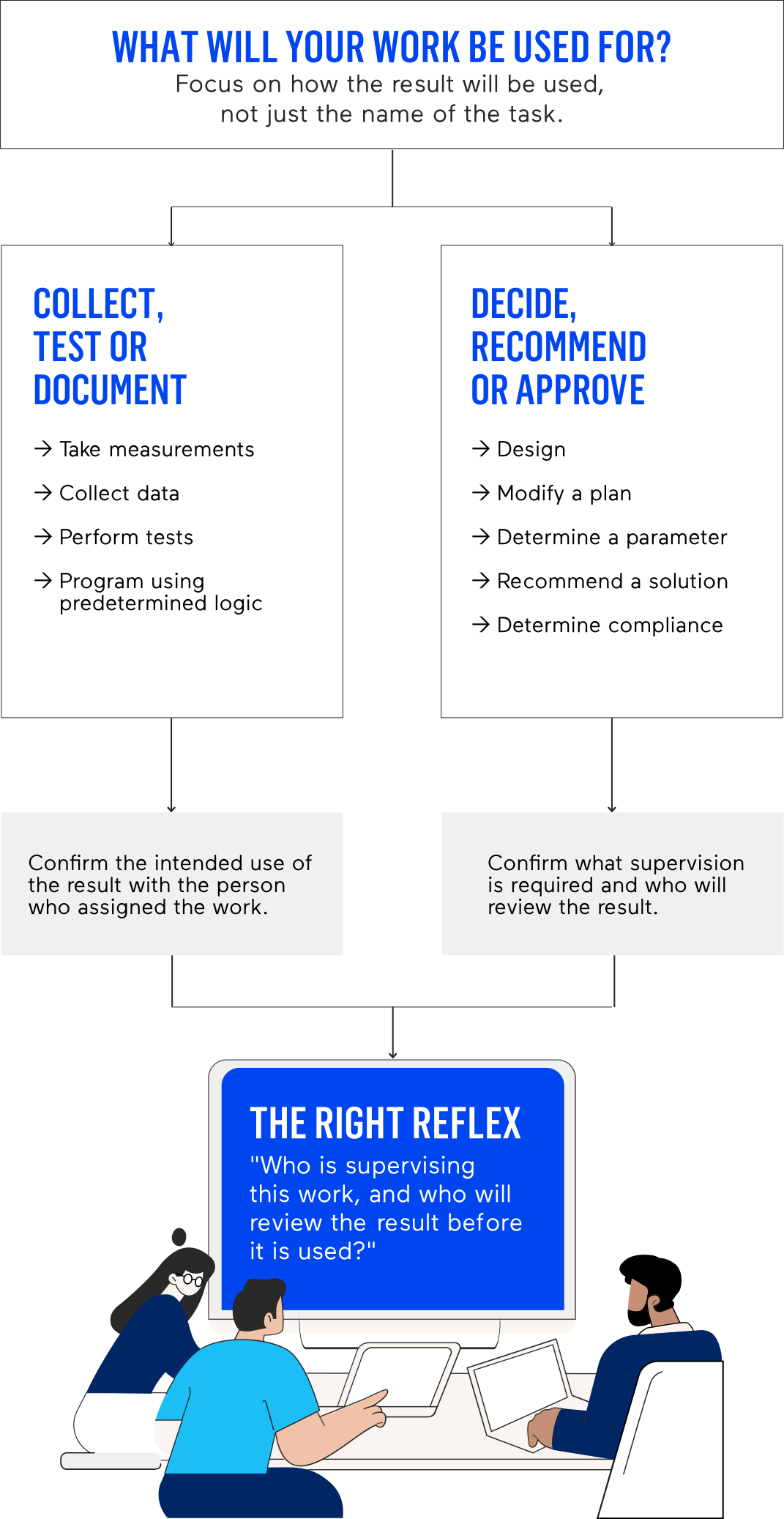
If you’re unsure whether the task contributes to a reserved activity and requires immediate control and supervision, ask the person who assigned the work or the engineer in charge of the project: “Who’s supervising this work? And who will review the result before it’s used?”
If you still have questions, contact the OIQ. This is exactly the kind of question you should ask before the work is submitted, used, or signed.


See also
CEP: Before you call yourself an engineer
You’re finishing your bachelor’s degree, you’ve completed several internships, and you may have certifications and [...]
A signature at the end—that’s not supervision
What real immediate control and supervision looks like
Graduate, intern, CEP: Can you use the title of engineer?
The straight answer: not until you’ve obtained your permit to practice and are registered on the OIQ’s Roll.