

29 septembre 2026
A signature at the end—that’s not supervision

What real immediate control and supervision looks like
You’re working on a plan, a calculation, a report, or a piece of code logic for a process. You put time and judgment into it—and maybe even break out in a cold sweat once or twice. Then, when it’s time to hand everything in, you’re told that an engineer will seal it.
That’s normal: you’re an intern or a CEP, not yet an “Eng.”
But signing it at the end isn’t really providing immediate control and supervision. Did this person understand your approach, ask questions, steer things back on course when needed and review your choices along the way? Or are they only seeing your work for the first time when they sign it?
Being under supervision isn’t about disappearing behind someone else’s signature. It’s about learning on real projects, with a professional who knows your reasoning, your choices, and your limits well enough to take responsibility for the result.
There’s supervision . . . and then there’s supervision
The word “supervision” can mean several things. Your manager can supervise your priorities, your schedule, or your tasks. The engineer who supports you as a CEP can help you develop your competencies, reflect on your practice, and work toward your permit. But if you contribute to a reserved activity, you need immediate control and supervision.
And that’s more than just keeping track of a schedule.
What does immediate control and supervision look like?
It isn’t necessarily someone sitting next to you all day, watching your every move. But it also isn’t someone who shows up at the end of a project to put their name on your work. To better understand what’s expected, it’s important to distinguish between three types of supervision.
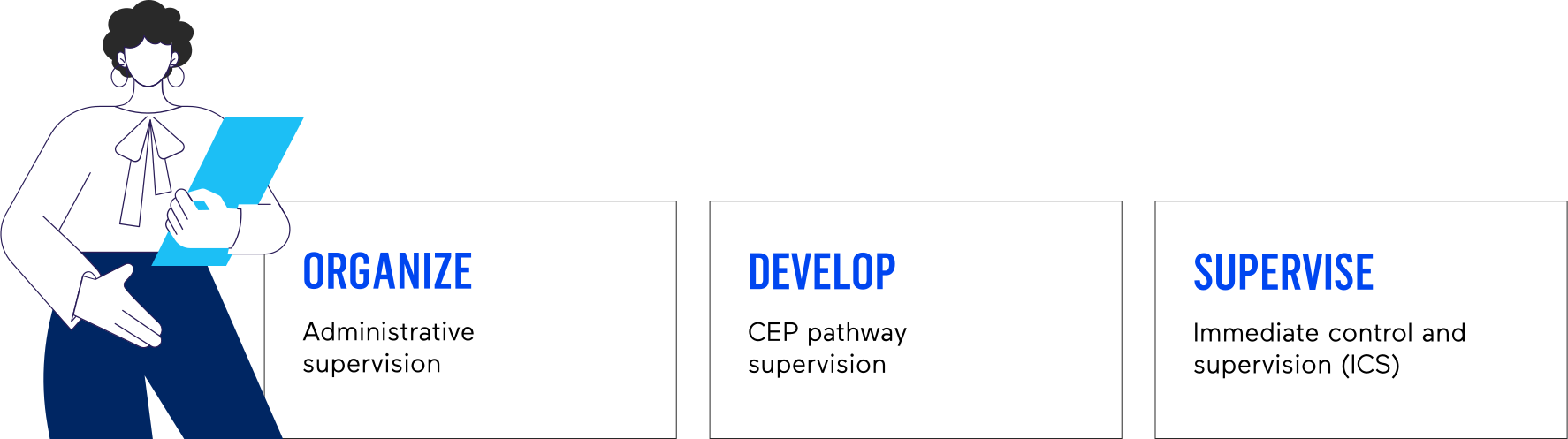
Three types of supervision, three different roles
Administrative supervision
This is supervision by the person who organizes your day-to-day work: tasks, priorities, deadlines, and integration into the team. This person must be an engineer.
CEP pathway supervision
An engineer supports you throughout the CEP pathway as you develop the competencies required to enter the profession: professional judgment, communication, ethics, autonomy, and an understanding of your role. This person is necessarily an engineer.
Immediate control and supervision (ICS)
This is the supervision required when you contribute to a reserved activity. The supervising engineer must understand your work, answer your questions, guide your choices, verify the results, and authenticate documents when required.
These roles can be handled by the same person . . . or not. If you contribute to a reserved activity, you need to know who’s wearing the ICS hat.
Signs that immediate control and supervision is lacking
A few red flags to watch for before you run into trouble:
- No one knows which engineer is supervising your work.
- You’re simply told: “Just do it. Someone will sign it later.”
- The responsible engineer isn’t really familiar with your project.
- You have no one to ask technical questions.
- Your work is submitted, used, or signed without proper review.
- Your manager isn’t an engineer but assigns you tasks involving reserved activities without direct technical supervision.
- You’re asked to produce a certification, a statement of compliance, or a technical recommendation as if you were an engineer.
How to ask questions without making accusations
If the supervision isn’t clear, there’s no need to be confrontational. The most effective approach is to steer the discussion back to the work at hand. Plus, you’ll look like you know what you’re doing. You can put it simply:
“Just so I know I’m doing things right, who’s responsible for the immediate control and supervision of this project?”
“When would you like to review my work before it’s submitted? Can we check in at this stage and again before the final version?”
“Who should I go to with technical questions? Who do I talk to if I get stuck? Because I’m an intern/CEP, not an engineer . . .”
“Since I contribute to a reserved activity, I want the supervision setup to be clear.”
ICS = a safeguard
Immediate control and supervision isn’t about checking every click as if one wrong move could blow up the whole project. ICS is a safeguard: it keeps you from having to shoulder responsibility alone for decisions that aren’t yours to make yet, while allowing you to learn on real projects.
As a CEP or intern, you can take the initiative when tasks involve reserved activities, since that’s where the greatest risk lies. For example, don’t wait until the end to get your work reviewed—have key steps checked along the way. Explain your approach and make sure the engineer in charge understands your work before signing it.
Asking for a clear supervisory framework isn’t just an administrative detail. It’s a professional instinct: you’re protecting your learning process, your future career, your team, your employer, and the public.


See also
Is it a prototype or an engineering project?
Short answer: It all depends on the potential consequences.
No engineers at your small business: a great internship or a...
Short answer: yes to both.
Graduate, intern, CEP: Can you use the title of engineer?
The straight answer: not until you’ve obtained your permit to practice and are registered on the OIQ’s Roll.